
Wandrille Potez in the Land of Eagles and Angels
There are places that seem to exist in a different rhythm of time—where the past lingers not as memory, but as a living presence. For photographer and researcher Wandrille Potez, Albania’s Drino Valley is one such place. Tucked between mountains and gorges, the valley shelters a constellation of post-Byzantine churches and monasteries, many of them little known, some almost forgotten. Wandering its paths with a camera in hand, Potez steps into spaces where history and humanity quietly converge, capturing fragments of a world as fragile as it is extraordinary.
Wandrille Potez
“EAGLES AND ANGELS”
© Wandrille Potez
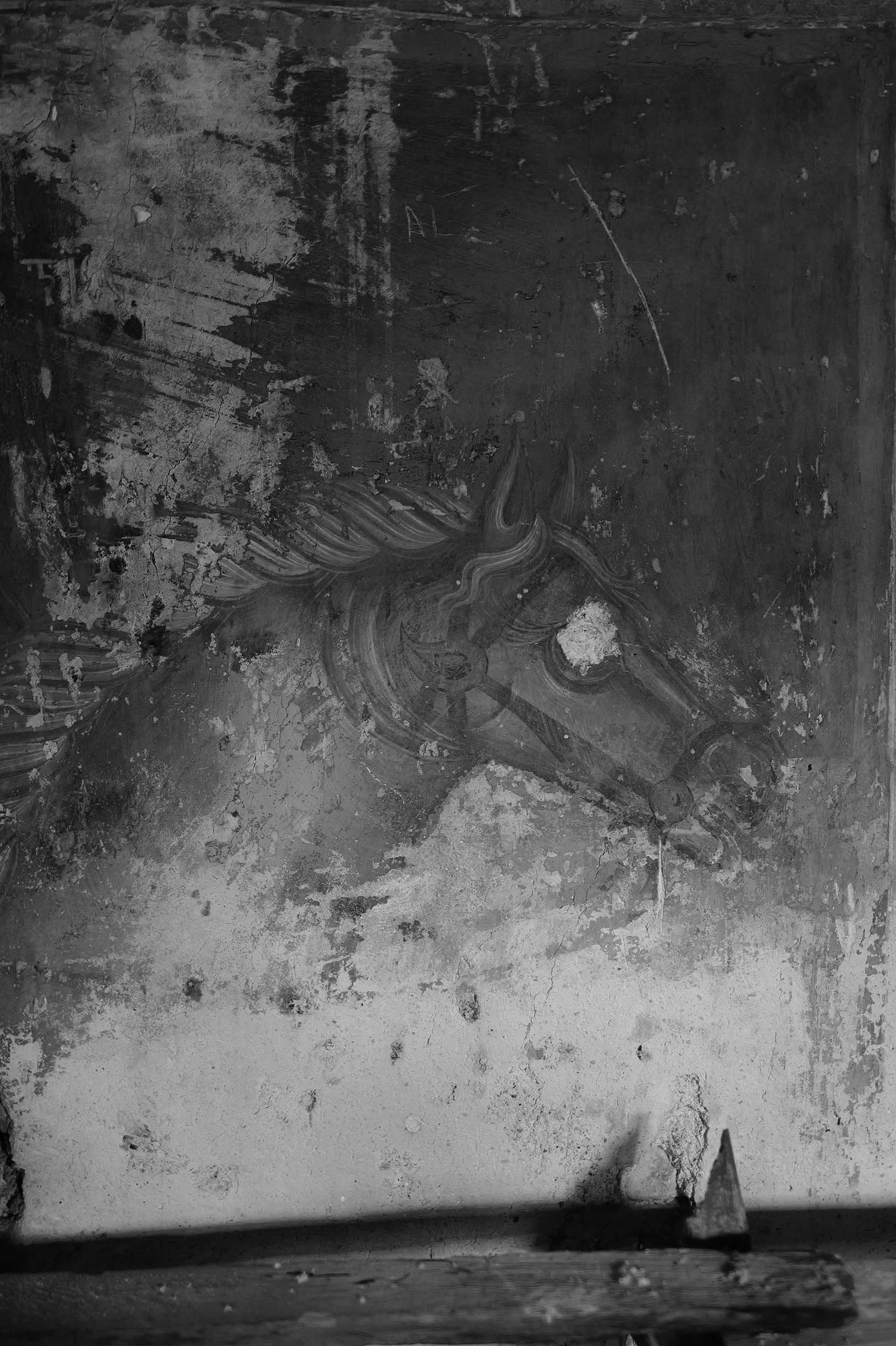
Dhuvjan, la fresque des saints cavaliers Dhuvjan.
The fresco of the holy riders Dhuvjan.
Kisha e Shën Kollit
Dropull Albania, February 2025
There are places that seem to exist in a different rhythm of time—where the past lingers not as memory, but as a living presence. For photographer and researcher Wandrille Potez, Albania’s Drino Valley is one such place. Tucked between mountains and gorges, the valley shelters a constellation of post-Byzantine churches and monasteries, many of them little known, some almost forgotten. Wandering its paths with a camera in hand, Potez steps into spaces where history and humanity quietly converge, capturing fragments of a world as fragile as it is extraordinary.
Potez’s work unfolds as a journey into hidden territories. He approaches these sites not as a distant observer, but as a participant in their ongoing story. His lens lingers on abandoned frescoes, weathered stone walls, and subtle traces of devotion—revealing both the tenderness and resilience of structures that have endured centuries of political shifts, neglect, and environmental exposure. In Albania, these churches are more than monuments: they are living testimonies to faith, endurance, and the quiet determination of local communities who have protected them against the odds.
© Wandrille Potez
Dhuvjan, la nef de l’église Saint-Nicolas Dhuvjan, The nave of Saint Nicholas Church Dhuvjan, Kisha e Shën Kollit
Dropull, Albania, August 2023
His encounter with Albania’s post-Byzantine heritage began in 2017. From 2022 onward, repeated journeys brought him deeper into the Drino Valley, where monasteries lie scattered across forests, ravines, and mountain slopes. Often absent from maps and difficult to access, these sites reveal themselves only after hours—or days—of walking. Over several years, Potez returned to the valley again, documenting its churches with the eye of an art historian, the curiosity of a journalist, and the patience of a photographer.
He studies their architecture and deciphers layers of Byzantine, Ottoman, and Latin influence, while also observing the quiet life that continues around them. Frescoes dating back to the 16th and 17th centuries narrate a spiritual life that resisted erasure. Local inhabitants sustain small rituals of remembrance: an oil lamp glowing softly, a dish of sweets left for travelers, water poured into sacred basins. Here, devotion and daily life merge seamlessly with nature—bats resting in shadowed vaults, snakes warming themselves on cracked stones, scorpions retreating beneath roof tiles.
The church of Saint Nicholas offers a telling example. Its frescoes, pale from centuries of exposure, have been covered after the roof was repaired, yet the scars of time remain visible, bearing witness to both vulnerability and care. Other sites, such as the Ravena Catholicon or the monastery of the Prophet Elijah, illustrate the deep entanglement of history, landscape, and community. Ruined conventual buildings open onto sweeping views of Mount Çajupi, while nearby residents continue to safeguard what they can. Even in isolation, life persists: animals inhabit the sacred spaces, and the distant melody of herds echoes through the valleys.
© Wandrille Potez
Mingul, les ruines du monastère de la Transfiguration Mingul, The ruins of the Monastery of the Transfiguration
Mingul, Kisha e Manastirit të Shpërfytyrimit
Lunxhëri Albania, August 2024
Potez’s practice sits at the intersection of photography, art history, and journalism, extending a long tradition of French travelers and photographers who, in the 19th century, documented the landscapes and monuments of the Ottoman Balkans and the Middle East. Like those early observers, he combines meticulous attention to detail with a deep curiosity for the stories embedded in buildings and landscapes. Yet his work is firmly anchored in the present, attentive to the fragility of sites threatened by disappearance. (1)
This commitment has already had tangible impact. At Potez’s initiative, the monasteries of the Drino Valley were included in the World Monuments Fund’s Watch List 2025—a crucial step toward mobilizing international attention and funding for their preservation.
The photographs produced through these journeys have been presented in several contexts. In 2024, Potez held his first exhibition dedicated to Albania, drawing from his Hors Sentier immersions. His work has also appeared in editorial and exhibition projects in France, in the nave of the Collège des Bernardins in Paris in September 2025, where the Drino Valley churches were introduced to a wider audience within a broader reflection on endangered European heritage.
© Wandrille Potez
Saraqinisht, l’ermitage de Spilea Saraqinisht, The cave hermitage of Spilea Saraqinisht, Shpella e Manastirit i Spilesë
Lunxheri Albania, August 2023
Between 2024 and 2025, the project entered a new phase through Potez’s residency at Vila 31 – Art Explora in Tirana. This residency allowed him to deepen his research while anchoring it more firmly in its local context. At Vila 31, the ex-house of the dictator who 60 years before banned the religion in Albania, Potez refined the project’s narrative structure, weaving together images, texts, and historical research. A publication untitled “Eagles and Angels” is currently in preparation, conceived as a book that brings photography and narrative into close dialogue.
In the Drino Valley, history, devotion, and nature exist in a delicate balance. Wandrille Potez’s work invites us to witness this convergence—and to recognize its vulnerability. In this land of eagles and angels, the monasteries stand as quiet witnesses to resilience, faith, and the enduring power of attentive looking.
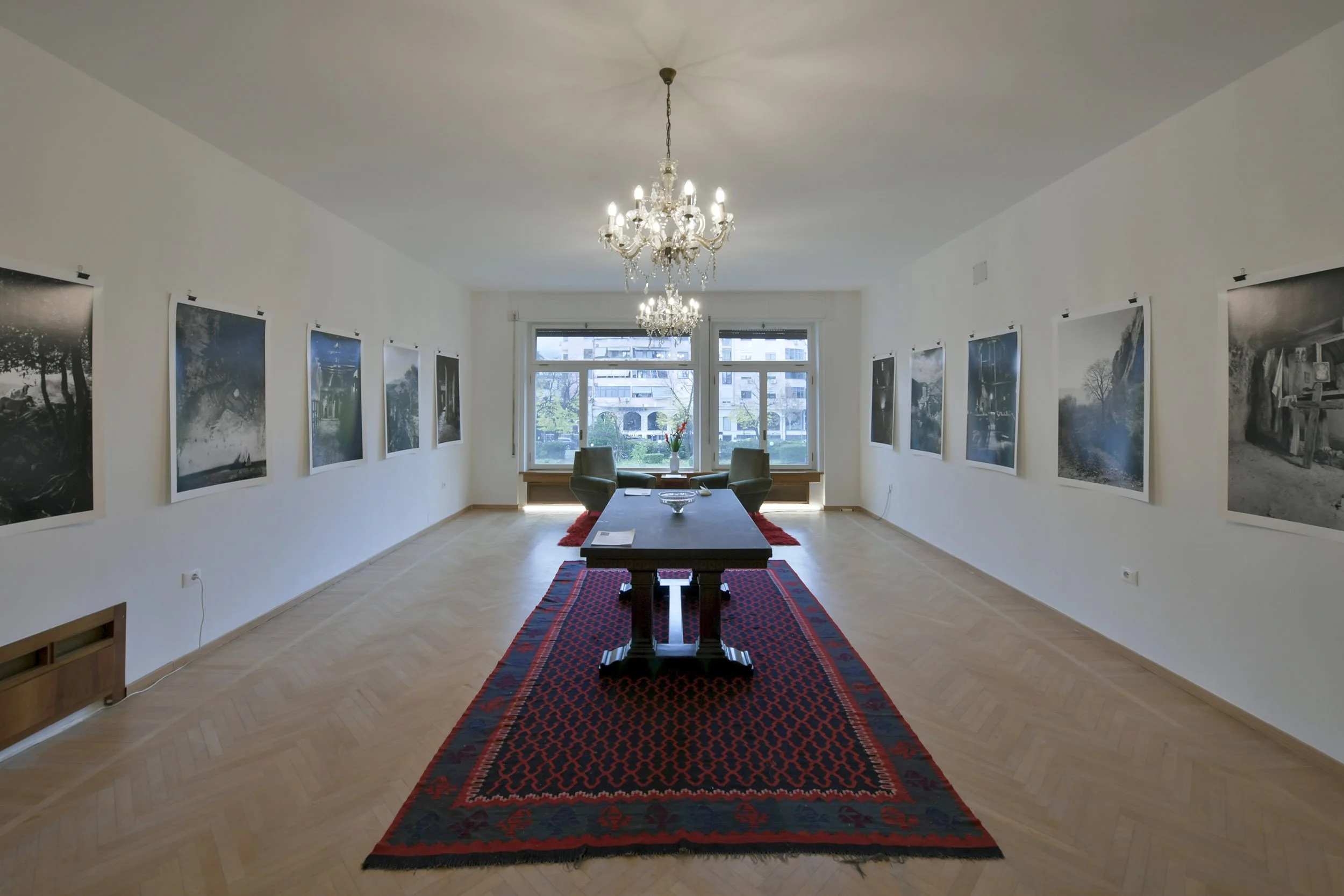
© Atdhe Mulla, Exhibition “Eagles and Angels” at Villa 31 during Wandrille Potez residency at Art Explora, Tirana, Albania November 2025
All photos courtesy of Wandrille Potez
(1) BIO: Wandrille Potez was born in Poissy, France in 1996. After completing a khâgne at the Lycée Janson de Sailly, his research – divided between the École Pratique des Hautes Études and Paris Diderot University – took him to Germany, where he became interested in the presence of the Orient in early 18th-century Saxon décor. With a master's degree in comparative history and civilisations, Wandrille Potez then worked as a researcher at the Centre de Recherche du Château de Versailles, before the Centre des Monuments Nationaux entrusted him with a curatorial assignment, in partnership with the Museum of Decorative Arts in Dresden. Between 2019 and 2023, while writing regularly for The Art Newspaper, Wandrille Potez made numerous trips to the Balkans, choosing photography as a means of defending the rare and fragile heritage he discovered there, on foot or by bicycle. At his suggestion, the churches in the Drino Valley were added to the World Monuments Fund's 2025 Watch List.

Eugène Atget
Eugène Atget is a French photographer, known for photographing the architecture of old Paris in the end of 19th century and beginning of 20th century. He is considered a modernist documentary photographer. Atget created an archive of 5,000 negatives and 10,000 prints, working on several photographic series, such as streets, houses, professions, parks.
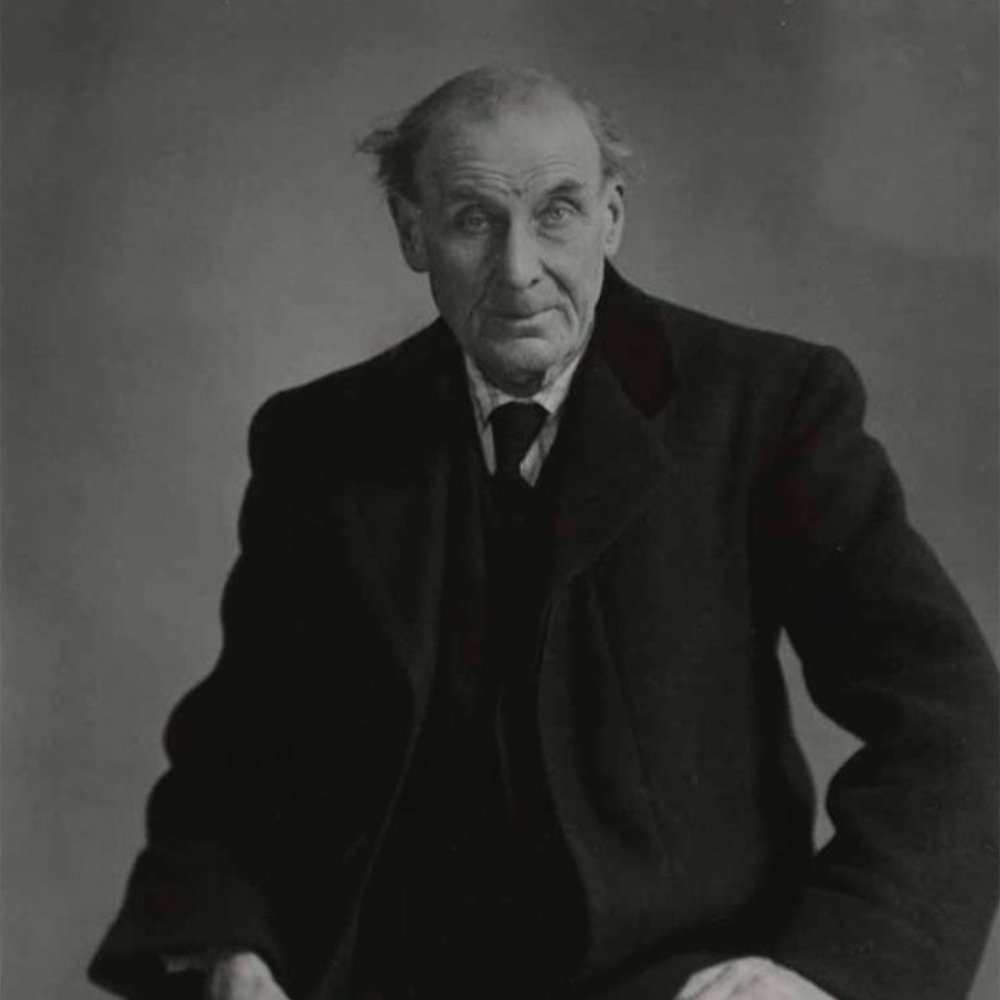
Eugen Atget, Portrait 1927 by © Berenice-Abbott
Eugène Atget
(Francë 1857 - 1927)
Eugène Atget is a French photographer, known for photographing the architecture of old Paris in the end of 19th century and beginning of 20th century. Atget is considered a modernist documentary photographer, although his work was mostly appreciated after his death, when Berenice Abbott bought the archive of his negatives and made them known in America through publishing books and exhibitions. Atget began photographing in his late thirties, in the end of the 1880s, when photography was becoming popular as a result of advances in technology. His first subjects were floral motifs and rural scenes, as study figures for painters and illustrators. But in the late 1890s, his focus shifted to architecture and streets of Paris, and continue to be for the next 30 years. During this period Paris had gone drastic changes known as Haussmann’s modernization projects, that razed old quarters to make place for wide boulevards and new bourgeois buildings. This operation, which was initiated by Napoleon III and undertaken by George-Eugene Haussmann between 1853-1927, was not supported by many. In this climate, Atget takes an interest in photographing what was left of old Paris; streets, old buildings, doors, windows, storefronts, stairs, parks, and other artifacts. In his business card reads "Creator and Purveyor of a Collection of Photograph Views of Old Paris". His clients were architects, painters who wanted exemplars of old architecture for their works, institutions of archives, and individuals who sought to have photographs of old Paris.
Atget created an archive of 5,000 negatives and 10,000 prints, working on several photographic series, such as streets, houses, professions, parks. Throughout his life, he used the old technique of photographing with view camera on 18x24 cm negative glass, which gave the photographs a contemplative feeling. During his time, his work was not considered art, as it did not enter into the canons of traditional Pictorialism, nor he was following the path of surrealist and constructivists of the modernist movement. Instead, he considered himself a documentary photographer. His work caught the attention of surrealist Man Ray and his assistant Berenice Abbott, who frequently visited his studio in the last years of his life, and after his death in 1927 bought the archive of 1,000 negatives and 10,000 prints. Abbott worked tirelessly to make Atget known in America through writings, books and exhibitions. Eugèn Atget's work served as inspiration for a new generation of photographers, such as Walker Evans, Ansel Adams, to represent the ordinary facts of life with clarity of vision and sensibility.

15 Quai Bourbon 1900, © Eugene Atget

Rue Houtefeuille, 6th Arrondissement 1898 © Eugene Atget

Bon Marche © Eugene Atget

Avenue de l’Observatoire, © Eugene Atget

Cour 7 Rue de Valence 1922, © Eugene Atget
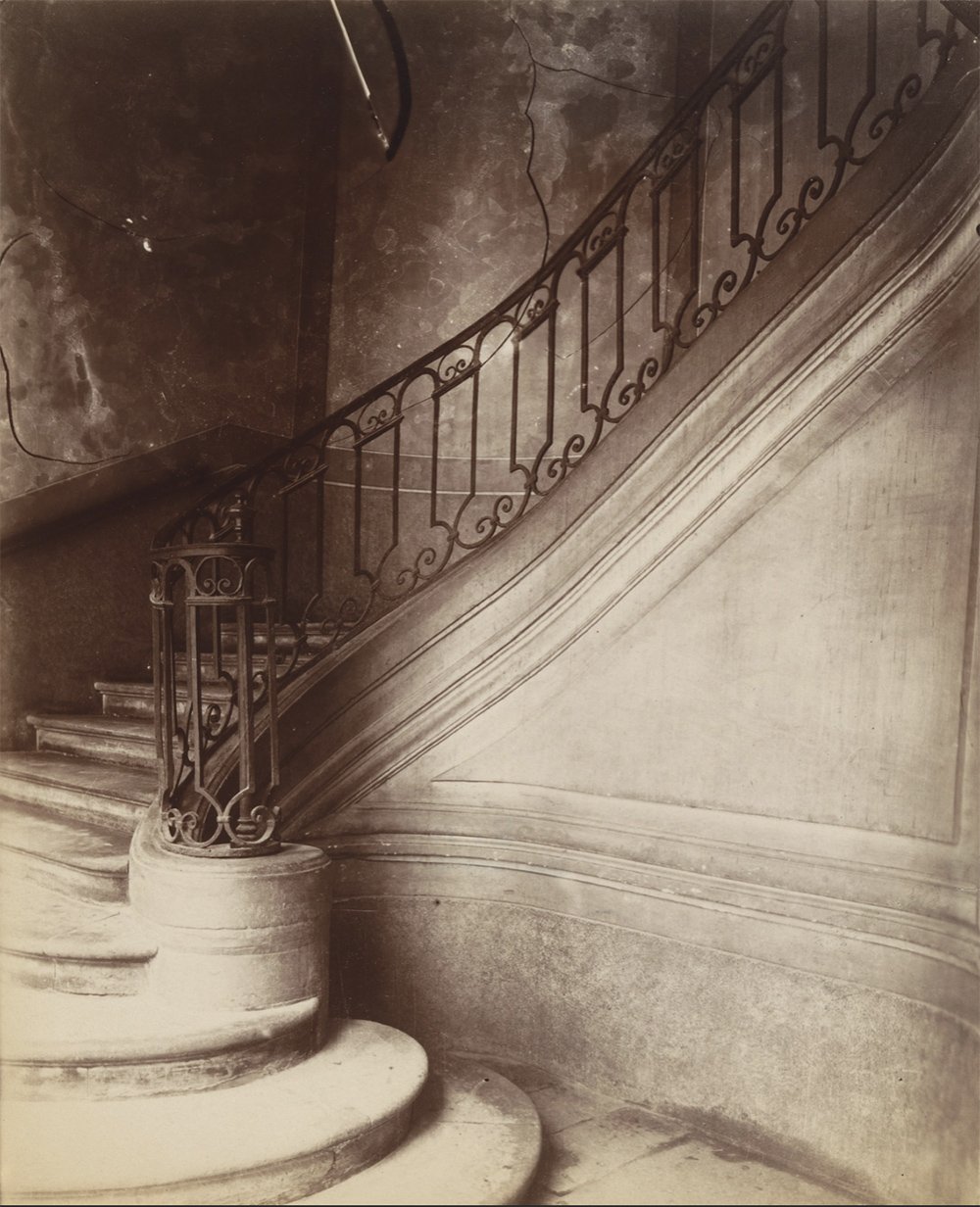
Hotel le Charron 1900, © Eugen Atget

Hotel de la Salamandre 1900, © Eugene Atget
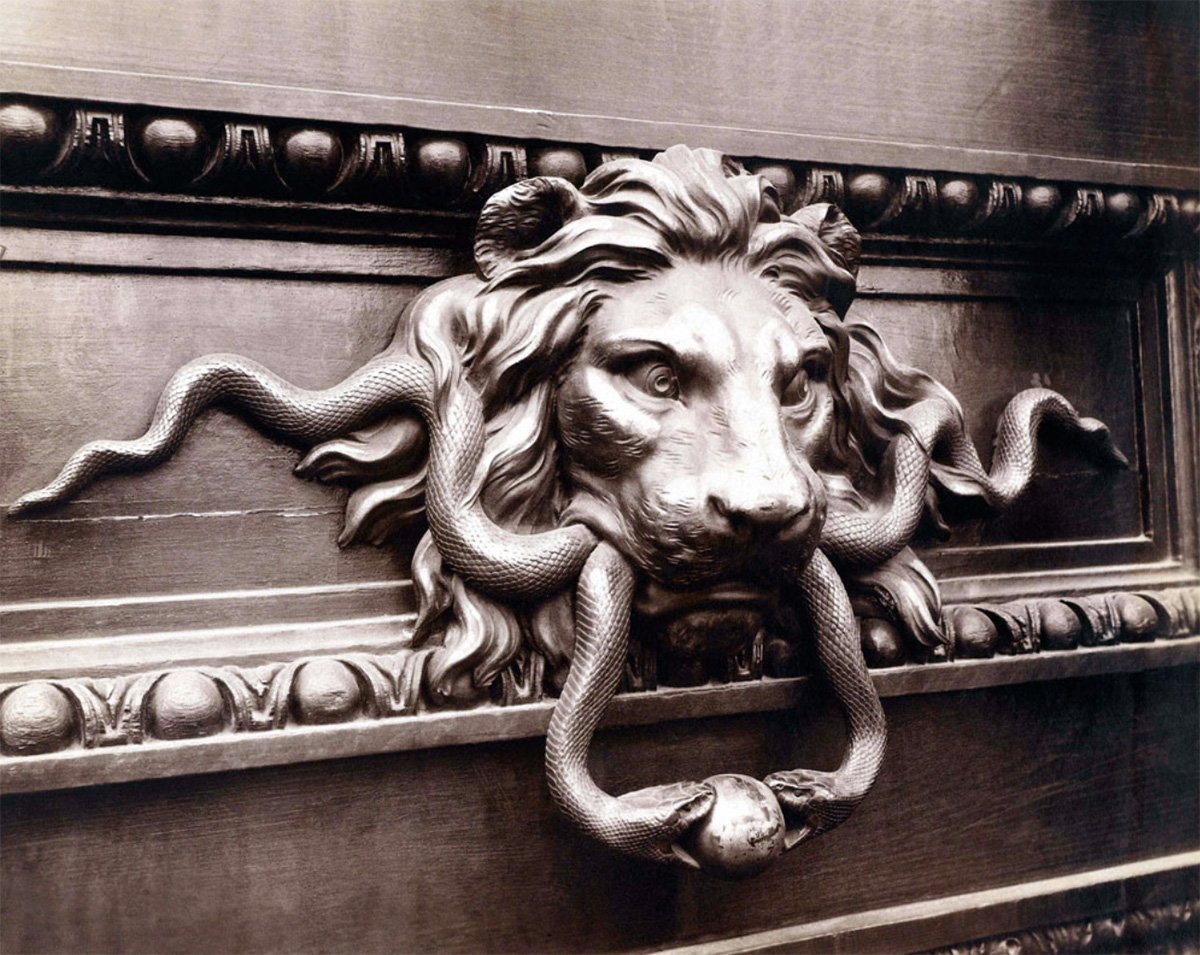
Lion head knocker 1900, © Eugen Atget

Rue de la Montagne Sainte Genevieve 1898, © Eugene Atget
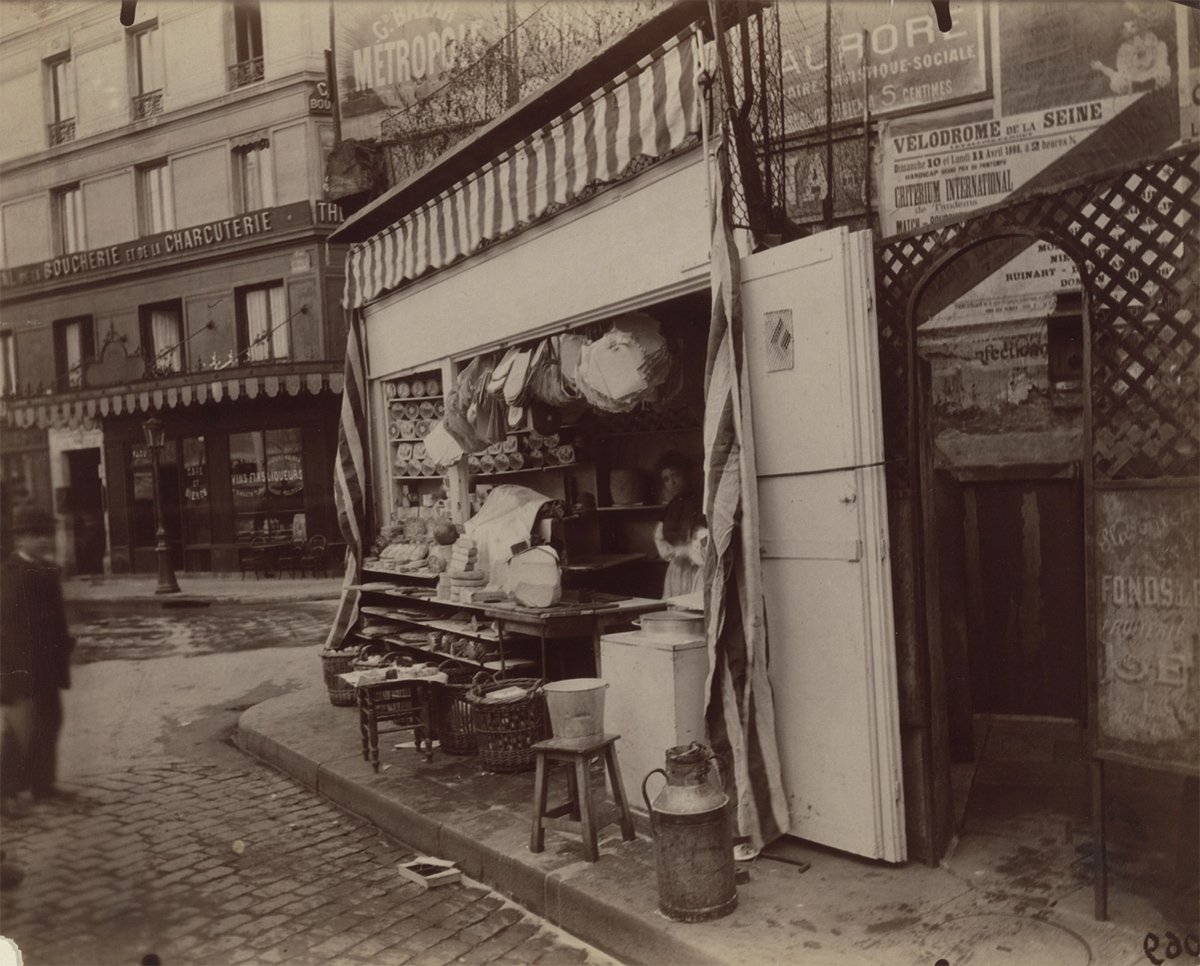
Untitled 1898, © Eugene Atget

Mitron 1899, © Eugene Atget

Marchand de paniers 1899, © Eugene Atget

Untitled 1900, © Eugene Atget

Rue de la Montagne Sainte Genevieve 1925, © Eugene Atget

Avenue des Gobelins 1927, © Eugene Atget

Pantheon Paris 1924, © Eugene Atget
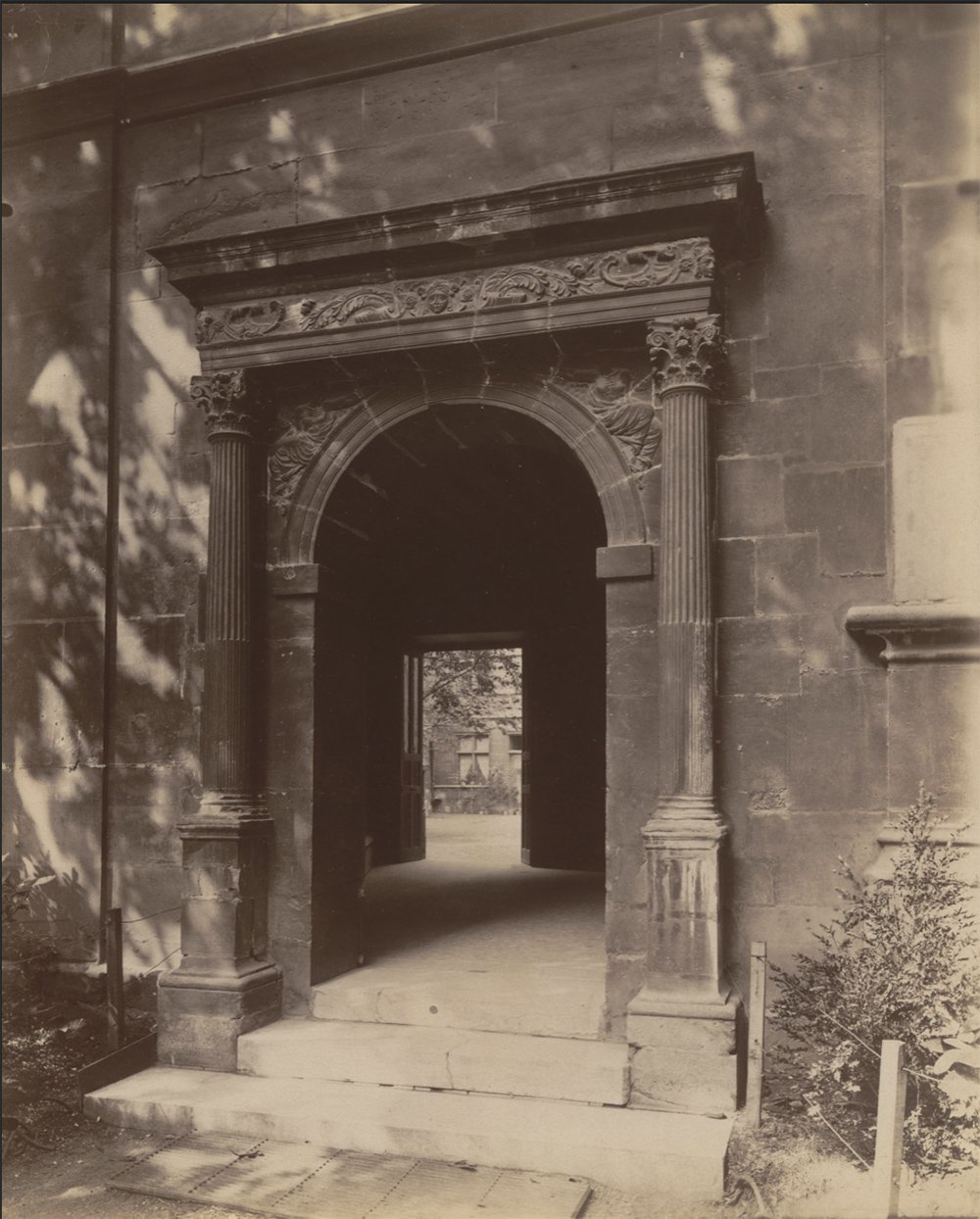
Porte Cluny 1898, © Eugene Atget

Grand Trianon 1924 © Eugen Atget.

Trianon Pavillon Francais 1924, © Eugen Atget
Selected Books about Eugène Atget


