
On the Artistic Practice of Olson Lamaj
Olson Lamaj is a visual artist and photographer based in Tirana, Albania. He studied Painting at the Academy of Fine Arts in Florence and completed a Master's degree in Artistic Photography at the Brera Academy of Fine Arts in Milan. His artistic practice explores the relationship between image, ideology, and collective memory, focusing on how political, social, and cultural systems construct identities and modes of representation…
Olson Lamaj
The City as Ideology, the Object as Symptom
© Olson Lamaj, Autoportrait from the series Between Pattern and Shadow
Olson Lamaj is a visual artist and photographer based in Tirana, Albania. He studied Painting at the Academy of Fine Arts in Florence and completed a Master's degree in Artistic Photography at the Brera Academy of Fine Arts in Milan. His artistic practice explores the relationship between image, ideology, and collective memory, focusing on how political, social, and cultural systems construct identities and modes of representation. Photography is the primary medium of his work, which he combines with research, artists' publications, and installation to create narratives that move between documentation and interpretation. In his work, photography functions not merely as a record of reality but as an artistic language capable of producing poetic, ironic, and at times theatrical narratives about everyday urban life.
Lamaj's artistic practice develops alongside his commitment to shaping and promoting the contemporary art scene in Albania. From 2012 to 2017, he co-founded MIZA Gallery, an alternative art space dedicated to supporting emerging artists and fostering a critical platform for contemporary art in Tirana. He is also the founder and editor of Pararoja Publishing House, an independent publishing platform focused on artists' books and the dissemination of visual narratives through zines and limited-edition publications.
Among his best-known projects and exhibitions are Between Pattern and Shadow, Transitioning into Green, Holy Muscle, (Over)Identification, and The Cat Above and the Mouse Below. He is the recipient of the Ardhje Award and has participated in international artist residencies in New York, Vienna, and Tirana. His work has been exhibited in museums, institutions, and galleries throughout Albania and across Europe.
About the Series Between Pattern and Shadow
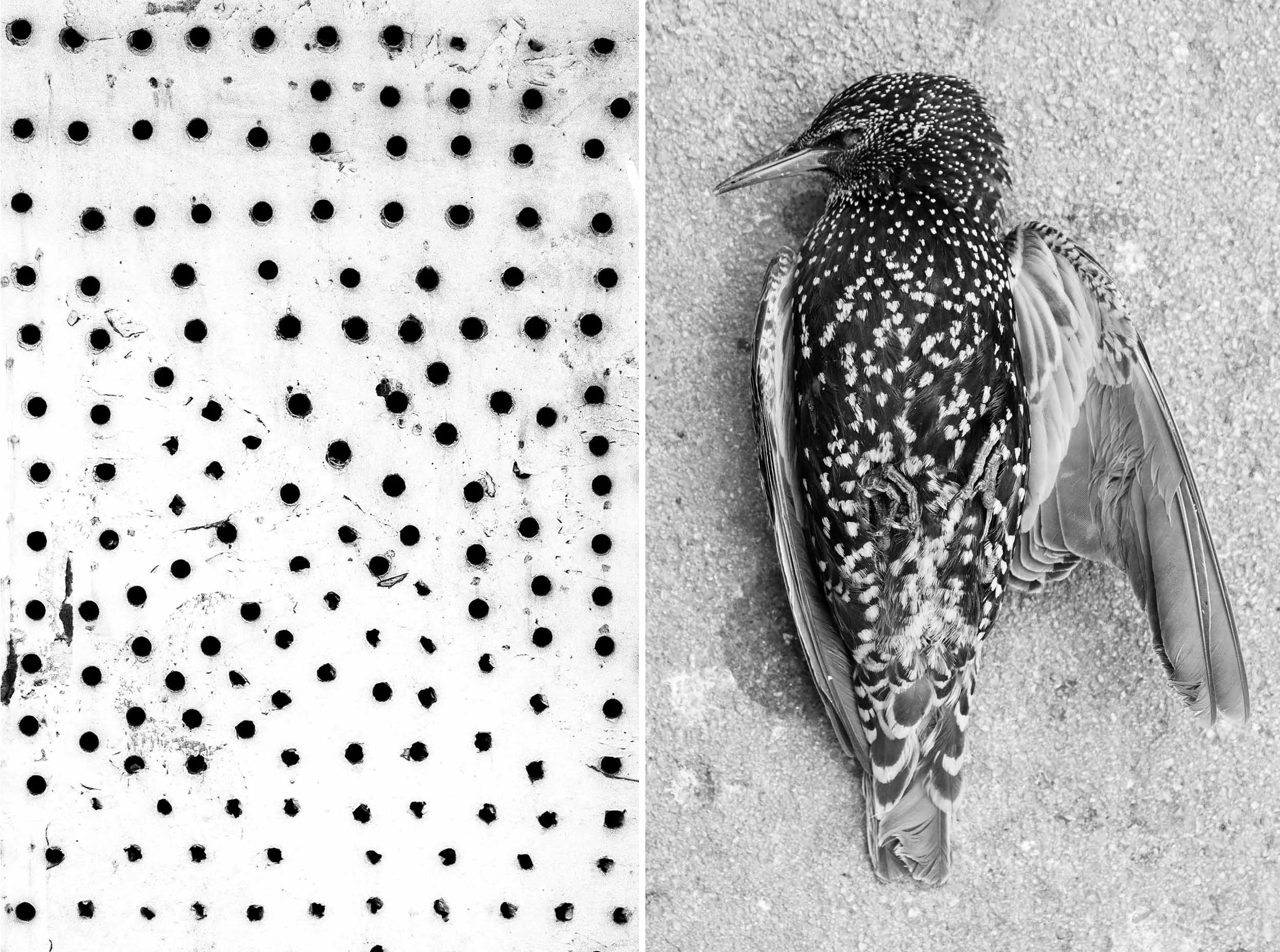
Between Pattern and Shadow is a photographic series born out of the everyday observation of the city of Tirana. It can be understood as a visual study of the aesthetics of Albania's post-socialist transition—not through major historical events, but through the urban landscape, ordinary objects, and the traces that architecture and everyday life have left upon the city.
In Lamaj's photographs, the city is not presented as a monumental landscape but as an organism composed of fragments. His attention is drawn to the elements that usually remain outside our field of vision: a plastic chair abandoned on the sidewalk, an improvised window, a crooked fence, a discarded tire, a dead bird lying on the asphalt, or the dense web of electrical cables stretching across building façades. These are not merely ordinary objects; they function as symptoms of a society in transformation. Rather than photographing tourist landmarks or the representative urban spaces of the city centre, Lamaj turns his gaze toward its margins. This approach aligns his practice with a kind of archaeology of the present, where the most commonplace objects become material evidence of the ideologies that continue to shape everyday life.
The Albania that emerged from the post-socialist transition did not produce a coherent Western modernity, but rather an urban landscape composed of historical layers, informal construction, architectural improvisation, and the remnants of a brutalist legacy. It is precisely this contradictory terrain that constitutes the material of Lamaj's photographs. Within this urban chaos, he seeks to uncover an everyday aesthetic, suggesting that chance, improvisation, and imperfection can themselves generate a visual language with a distinct identity.
In this sense, the city is not portrayed through heroic landscapes or romantic notions of national identity, but through fragments of contemporary Albanian reality. Post-socialist capitalism intertwines with nationalist symbolism: eagles, stars, and patriotic iconography coexist alongside unfinished roads, exposed concrete, and informal construction, producing a landscape in which the contradictions of transition become unmistakably visible.
His compositions are calm, frontal, and carefully controlled. This distance is not intended to suggest neutrality; rather, it establishes a particular mode of reading. Objects are photographed as though they were archaeological artefacts—material witnesses to a historical period that continues to generate new forms of urban life. Lamaj is particularly interested in the ways urban elements produce accidental visual rhythms: electrical cables trace abstract compositions, shadows interrupt façades, while plastic, metal, and concrete establish unexpected formal relationships.
Photography here operates not simply as a means of recording reality, but as an analytical tool through which the urban landscape can be read as a cultural and ideological structure.
The title itself, Between Pattern and Shadow, encapsulates this relationship. "Pattern" refers not only to the graphic arrangements that emerge across the photographic surface, but also to the invisible political, economic, and cultural structures that organise urban life. "Shadow," by contrast, represents everything that escapes planning: improvisation, chance, memory, and those spaces where systems lose control.
Between Pattern and Shadow is ultimately more than a photographic series about Tirana. It is a reflection on how photography can read the city as a cultural text, where every object, every surface, and every trace contains invisible histories. Lamaj does not photograph the city simply to show what Tirana looks like; he photographs it to understand how history, politics, and ideology continue to manifest themselves upon its surface. In this sense, the urban landscape is not merely the backdrop to social life, but the material form through which history continues to be written.
Interview with Olson Lamaj
Alketa Misja for Tatì Space: Hello Mr. Lamaj! Thank you very much for accepting the invitation to be interviewed by Tatì Space and sharing your thoughts about your work with our readers.
In your series Between Pattern and Shadow, you repeatedly return to the everyday fragments of the city. What draws you to these urban details, and how do you understand the relationship between Albania's post-socialist transition and the aesthetic produced by the city?
Olson Lamaj: For years, I have made it a habit that whenever I leave home, I take my camera with me—even when I'm not sure I'll use it. This constant routine, combined with an attentiveness to the materiality of the city, has gradually allowed me to build a personal archive of the urban landscape in its everyday condition.
What has always interested me is not the city as a finished image, nor architecture as an isolated object, but the way the city is produced through small interventions, improvisations, and everyday gestures. Within these fragments I have found an unexpected aesthetic, where the old and the new are not in clear opposition but coexist in an irregular and often contradictory way.
In this sense, transition is not merely a historical backdrop but an ongoing condition of the city itself, continuously generating new visual forms—often unexpected, yet deeply revealing of the way we experience the spaces we inhabit.
Tatì Space: Cables, plastic, fences, concrete, stray animals, and temporary structures frequently appear in your photographs as central elements of the image. Rather than remaining incidental details of the urban landscape, they can be read as signs of a broader social and ideological reality. What do these ordinary objects represent for you, and why do you think they are important to understanding post-socialist Albania?
Olson Lamaj: These urban objects are, in a way, the raw material from which I construct my photographs. Cables, concrete, plastic, fences, and temporary structures are not simply accidental features of the city; I see them as traces of the way it has been built and continues to transform. They constitute a kind of visual matter through which one can read not only the city's physical form, but also its social and historical condition.
At the same time, stray animals—birds and dogs in particular—play a very important role in my work. For me, they are equal inhabitants of the city, inseparable from its existence. I often feel a sense of empathy towards them, as though, in a quiet way, I recognize something of myself in their presence—in the way they move, adapt, and negotiate the urban environment.
There is something profoundly genuine in this coexistence between nature and the city, even when it unfolds under difficult conditions. In a way, these figures embody a quiet resilience and an ability to find their place within urban chaos. That sensitivity, that direct relationship with them, often becomes part of the way I observe and photograph the city.
Tatì Space: Your compositions are often frontal, calm, and marked by a noticeable emotional distance. At the same time, many of your photographs create graphic rhythms and abstract relationships between form, shadow, and texture. To what extent do you see photography as a document of social reality, and to what extent as a formal or abstract visual structure?
Olson Lamaj: I believe this way of photographing is directly connected to my artistic education. Having studied painting and coming from a visual arts background has led me to think constantly in terms of composition. There is a natural need for me to organize the elements within the frame with precision, often pursuing a certain kind of compositional "perfection."
When I stand before a subject, I frequently change my point of view until every element within the frame functions as part of a single visual structure. It is a highly intuitive process, yet at the same time a very controlled one—a kind of dialogue between myself and the subject.
In this sense, photography, for me, comes close to constructing a painting. Urban elements such as cables, wires, or architectural structures often appear to me as brushstrokes within an informal painting, where the city itself becomes an open canvas.
Tatì Space: Patriotic symbols, advertisements, kitsch objects, and traces of urban decay often coexist in your work, creating a subtle sense of humour and absurdity. These images can be read as reflections on the ways consumerism and national identity have become intertwined in post-socialist Albania. Do you see post-socialist consumerism as a new form of visual ideology, and what role does irony play in the construction of your images?
Olson Lamaj: Political and social concerns are not simply thematic layers in my work; they are structural conditions that shape it. In the Albanian context, where politics does not function merely as a background but as a regime of everyday life, urban space itself becomes a field in which ideologies are constantly materialized through objects, remnants, and built forms.
My practice seeks to read the city as an open archive of transition, where past and present are not separated in a linear way but coexist as overlapping layers. The post-socialist landscape does not produce a new homogeneous order, but rather an economy of fragments: abandoned structures, unfinished infrastructure, and signs of late capitalism that continuously intervene upon one another. Within this entanglement, the ordinary object is never neutral; it functions as a symptom of a historical and ideological system in constant transformation.
In this sense, what is often perceived as urban chaos is not the absence of order, but a new form of visual rationality, where ideology is no longer articulated through official statements but through the materiality of everyday life. Humour and irony, in this context, do not serve as aesthetic relief but as mechanisms of critical distance, making the internal contradictions of this visual regime visible.
Tatì Space: Your practice seems less interested in constructing linear narratives than in examining how power, memory, and culture become materialized within urban space and everyday objects. Do you see photography as a tool capable of revealing the invisible social, political, and cultural structures of a society?
Olson Lamaj: Yes, fundamentally that is precisely what my photography attempts to do: to read and make visible the structures that usually remain invisible in everyday life. I am not interested in photography as a straightforward record of reality, but as a means of analyzing it.
Within urban space, power, memory, and culture rarely appear in explicit or narrative forms. Instead, they materialize through dispersed, often modest manifestations: objects, architectural interventions, the organization of space, and the ways in which that space is occupied and used. Photography allows me to read these layers as a kind of open text.
In this sense, the image is not simply a representation of reality, but a mode of thinking—an instrument through which reality can be understood by reading its visual traces.
Tatì Space: Thank you, Olson, for sharing your thoughts and reflections with us. We wish you every success with your future artistic projects